
Safety & Compliance
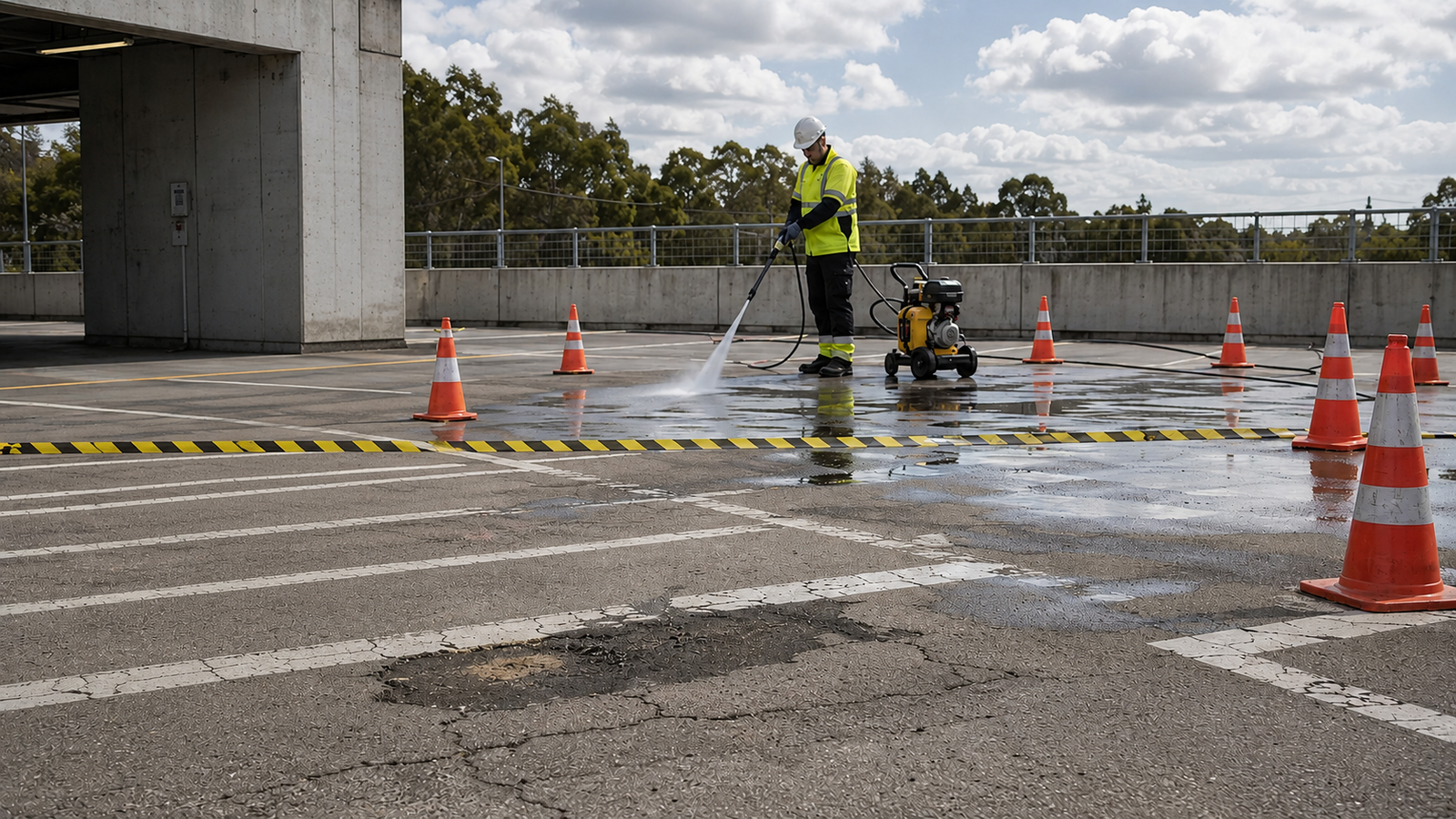
Commercial car park surfaces operate in conditions that create a continuous cycle of contamination accumulation. Every vehicle that enters and exits deposits some combination of petroleum-based fluids, brake dust, tyre rubber compounds, road grime and moisture onto the surface. In covered car parks, limited airflow and temperature variation create conditions that support biological growth — mould, algae and lichen that colonise the concrete substrate and dramatically reduce surface friction.
For most facilities, the resulting contamination profile represents a genuine and material safety risk — and a corresponding legal exposure for the property owner or occupier that should not be underestimated.
The legal framework: duty of care in commercial car parks
Property owners and occupiers of commercial car parks in Queensland owe a duty of care to all users of those facilities under both the Civil Liability Act 2003 and the Work Health and Safety Act 2011. This duty extends to maintaining surface conditions that do not create unreasonable risk of harm — and it is not discharged simply by conducting reactive cleaning in response to visible contamination or following a reported incident.
Courts in Australian jurisdictions have consistently found that property owners who allow contamination to persist on publicly accessible surfaces over extended periods, without evidence of systematic maintenance and inspection, have not met the reasonable care standard — regardless of whether a specific incident was foreseeable. The standard expected is proactive, systematic maintenance, not reactive response.
High-risk zones that require priority attention
Within any commercial car park, certain areas carry significantly elevated risk and require more frequent attention than general parking bays. Entry and exit ramps present the highest risk profile — vehicle braking on a contaminated gradient surface creates conditions where loss of traction is most likely to occur, and where the consequences are most severe. N Floorcare's car park programs apply heightened service frequency to ramps, prioritising them for treatment at every visit.
Undercover areas with high vehicle dwell time accumulate oil drip contamination at rates significantly higher than open-air parking — and because they are sheltered from rain, self-cleaning by precipitation does not occur. Entry points where pedestrians cross vehicle lanes, lift lobbies and stairwells with wet-zone interfaces are additional priority areas that require dedicated attention in any comprehensive car park maintenance program.
Building a defensible maintenance record
The practical value of a systematic car park maintenance program extends beyond the surface conditions it creates. Documented, regular maintenance creates an evidentiary record that is directly relevant to the defence of liability claims arising from incidents on the property. N Floorcare maintains comprehensive service records for all car park maintenance programs — including visit dates, areas treated, equipment and methods used, and post-cleaning condition observations — providing property managers with a complete and audit-ready documentation trail.
This documentation, combined with the consistent surface conditions produced by a professional maintenance program, represents the most robust available basis for demonstrating reasonable care in the event of a legal challenge.
The specialist difference in car park maintenance
Hot water pressure washing — using equipment that heats water to temperatures effective in breaking down petroleum compounds and biological growth at the molecular level — produces significantly better results on contaminated car park surfaces than cold water pressure washing or conventional scrubbing. N Floorcare deploys hot water commercial pressure washing equipment calibrated to the specific contamination profile of each site, combined with appropriately selected treatment chemicals where biological growth or heavy petroleum contamination requires additional intervention.