
Surface Protection
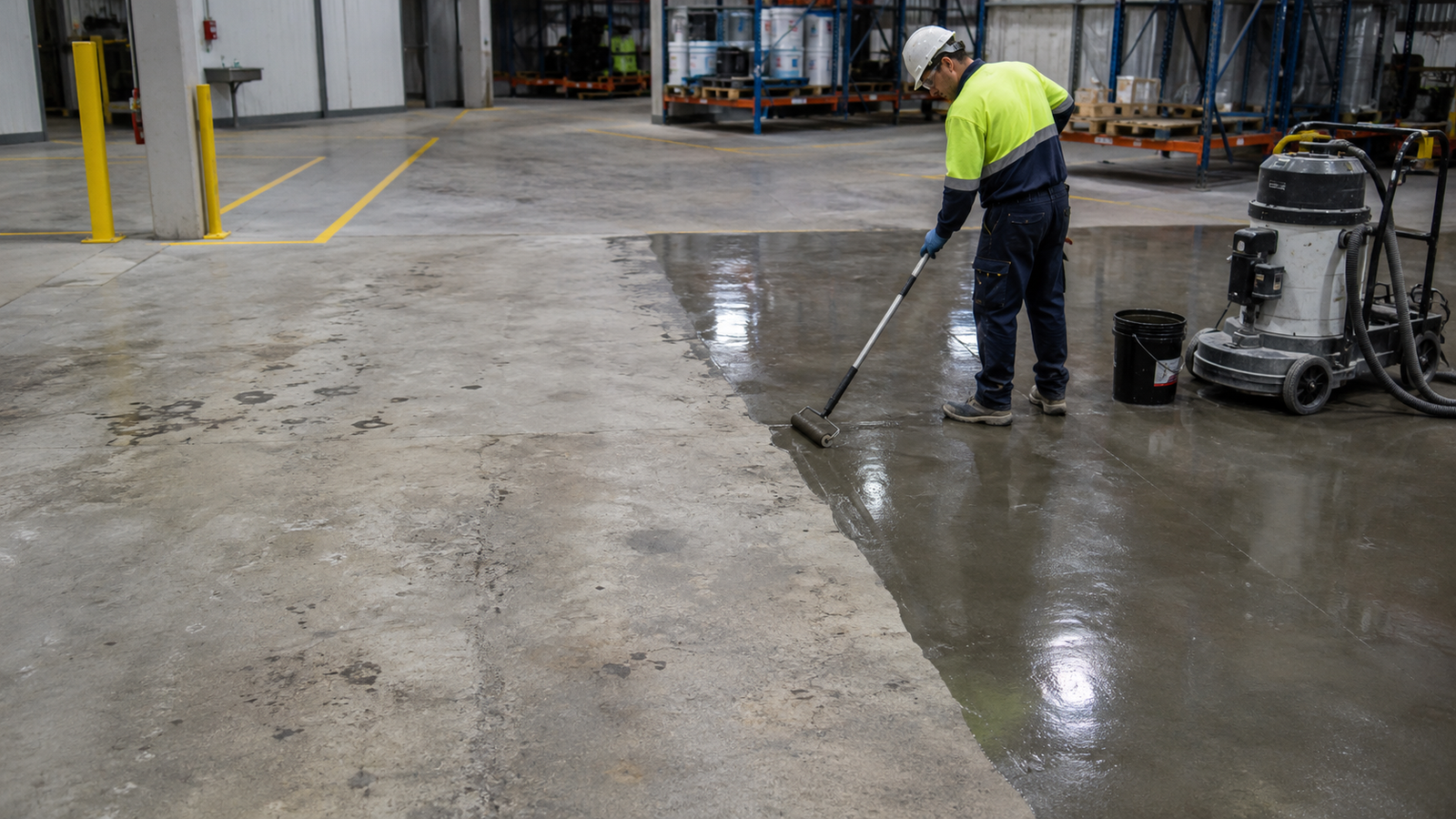
Concrete is one of the most durable flooring materials available for commercial and industrial use, but this durability is fundamentally conditional — it depends on the concrete being adequately protected from the environmental conditions and contamination sources it encounters in service. An unsealed or inadequately sealed concrete floor is not simply a surface that looks worse than a sealed one. It is a substrate that is actively degrading — and the rate of degradation accelerates as damage accumulates and the surface becomes progressively more porous and vulnerable.
Understanding the stages of concrete degradation and the indicators that signal each stage allows facility managers to intervene at the point where treatment is most straightforward and effective — rather than at the point where remediation becomes a major project.
Stage one: dusting and surface porosity
The earliest and most readily observable indicator that concrete requires sealing is dusting — the appearance of fine grey powder on the surface, particularly noticeable after sweeping or in areas of concentrated foot traffic. Concrete dust indicates that the surface is experiencing abrasion at a level that is releasing fine concrete particles. This occurs when the surface laitance — the weak outer layer of concrete that forms during curing — has been exposed by vehicle traffic, cleaning activity or surface wear, and is progressively disintegrating.
In a sealed concrete floor, the sealant prevents this laitance layer from becoming the wearing surface and protects the sounder concrete beneath. In an unsealed floor, the laitance breaks down and releases fine silica dust that has direct implications for air quality in the facility and becomes a secondary source of abrasive contamination that accelerates further surface wear.
Stage two: persistent staining and contamination absorption
When spills — oil, chemical, water-based liquids or organic material — penetrate the concrete surface and cannot be removed by routine cleaning, the floor has passed the threshold where surface cleaning alone is adequate. Concrete without an effective sealing system is porous at the microscopic level, and liquids migrate into this pore structure within seconds of contact with the surface.
Once a contaminant has penetrated into the concrete pore structure, it cannot be removed by surface cleaning. It may be possible to reduce the visual impact of deep staining through specialist chemical treatment combined with grinding, but permanent staining often requires removal of the affected surface layer entirely. The correct intervention, before this point is reached, is the application of a penetrating sealant system that closes the pore structure to liquid ingress while the surface is still in sound condition.
Stage three: surface roughening and texture change
As concrete wears without adequate sealing protection, the surface texture changes. What began as a relatively smooth, consistent surface develops a rough, gritty feel as aggregate particles are exposed by the progressive removal of the cement matrix surrounding them. This roughening has direct implications for both cleanability and slip resistance — rough concrete is significantly harder to clean effectively, because contamination lodges between aggregate particles and resists mechanical removal, and because the increased surface area retains contamination in proportionally higher quantities.
Stage four: visible cracking and edge deterioration
Surface cracking in concrete floors — particularly at expansion joints, control joints and the edges of existing damage — indicates that moisture has penetrated the substrate and is contributing to both chemical and mechanical deterioration. Once water enters a crack, the cycle of wetting and drying, combined with any freeze-thaw cycling in cold storage environments, progressively widens and deepens the damage.
At this stage, a simple reseal is no longer sufficient. The cracks must be addressed first — cleaned, assessed for structural significance, and treated with appropriate flexible joint sealant or epoxy repair compound — before any surface sealing program is applied. Sealing over unaddressed cracking seals moisture into the substrate rather than preventing it from entering, accelerating deterioration rather than arresting it. This is exactly the kind of assessment that specialist floor care providers conduct as a matter of course, and that generalist cleaners routinely miss.
The specialist approach to concrete sealing
Effective concrete sealing is not a single product applied in a single visit. It is a systematic process: assessment of substrate condition and contamination profile, appropriate mechanical preparation (typically diamond grinding or shot blasting), surface testing for pH and moisture content, product selection based on site-specific requirements, application in accordance with manufacturer specification and environmental conditions, and ongoing monitoring to identify the point at which re-treatment is required. N Floorcare conducts this full process as standard — because any shortcut in the process produces a result that underperforms against the standard a correctly executed program can deliver.