
Car Park Surface Maintenance
The surface condition of a commercial car park carries direct implications for occupier safety obligations, public liability exposure and the overall impression your property makes on visitors, tenants and clients.
The surface condition of a commercial car park carries direct implications for occupier safety obligations, public liability exposure and the overall impression your property makes on visitors, tenants and clients.
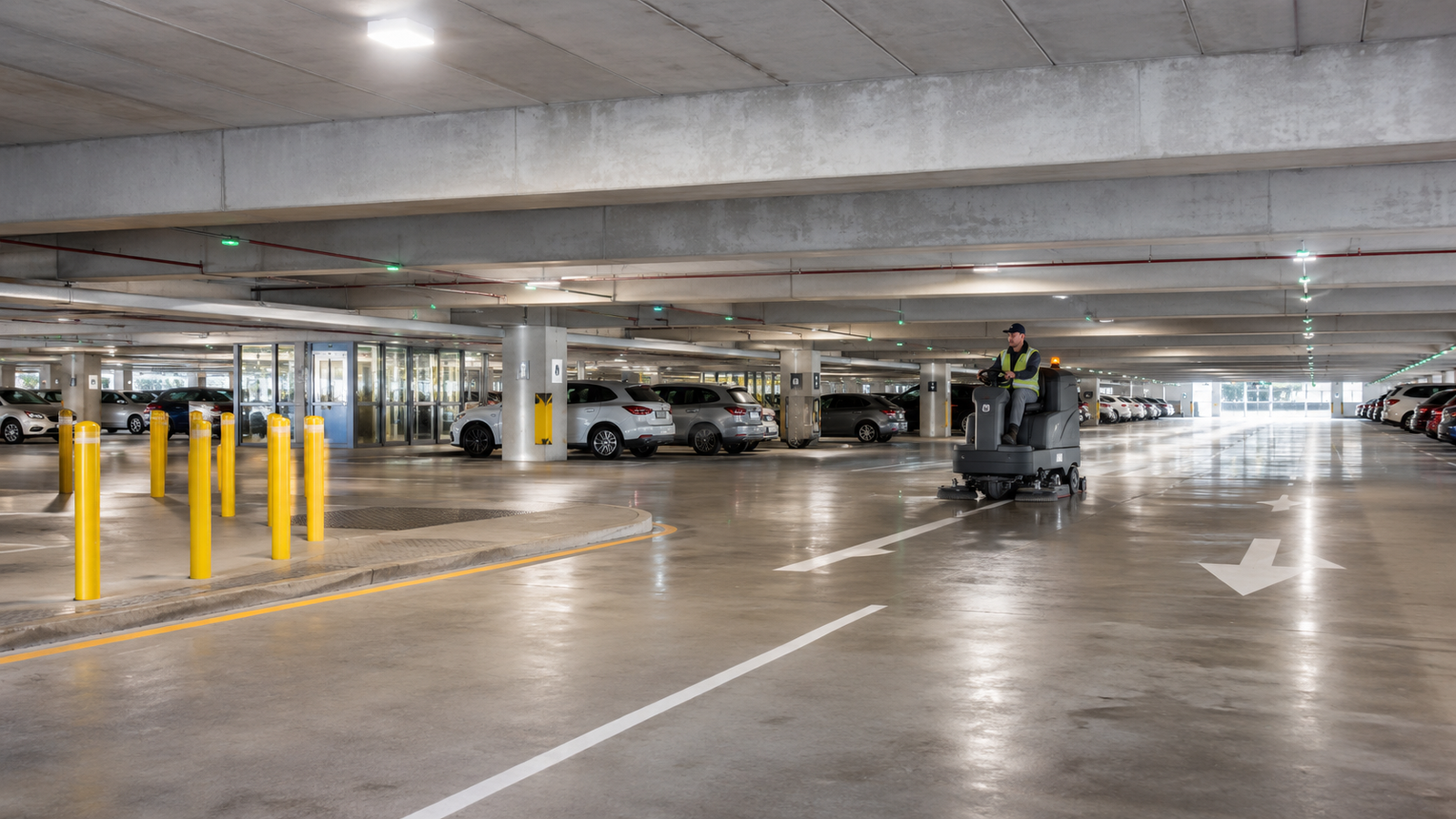
Commercial car parks accumulate a complex and hazardous contamination profile over time. Vehicle traffic deposits petroleum-based fluids, brake dust, tyre rubber compounds and general atmospheric grime onto concrete and asphalt surfaces continuously. When combined with moisture — whether from rain, condensation or cleaning activity — these deposits create surface conditions with dramatically reduced friction coefficients, significantly elevating slip risk for pedestrians and the handling risk for vehicles on ramps and turning areas.
Under the Civil Liability Act and relevant WHS legislation in Queensland, owners and occupiers of commercial car parks have a non-delegable duty to maintain surfaces in a condition that does not expose users to unreasonable risk. Courts in Australian jurisdictions have consistently found that visibly contaminated or deteriorated car park surfaces fall short of this standard where the contamination was persistent and the duty-holder had the means to address it.
N Floorcare's car park maintenance programs provide property owners and managers with documented, systematic evidence of proactive surface management — the clearest available demonstration that reasonable care has been exercised in discharging the duty.
Not all areas of a car park carry the same risk profile. Ramps, entry and exit points, undercover sections with high vehicle dwell time and areas immediately adjacent to building entries carry significantly elevated risk — from both contamination accumulation and the concentration of pedestrian-vehicle interaction. N Floorcare's programs apply heightened service frequency to these zones, with standard frequency maintained across lower-risk bays and perimeter areas.
Contamination build-up on car park surfaces progressively reduces the visibility of line markings — creating traffic management and accessibility compliance issues in addition to the primary slip hazard. Systematic pressure washing restores marking visibility, and N Floorcare's post-cleaning inspection process identifies markings that require repainting so that your property manager can schedule remediation before compliance obligations are compromised.