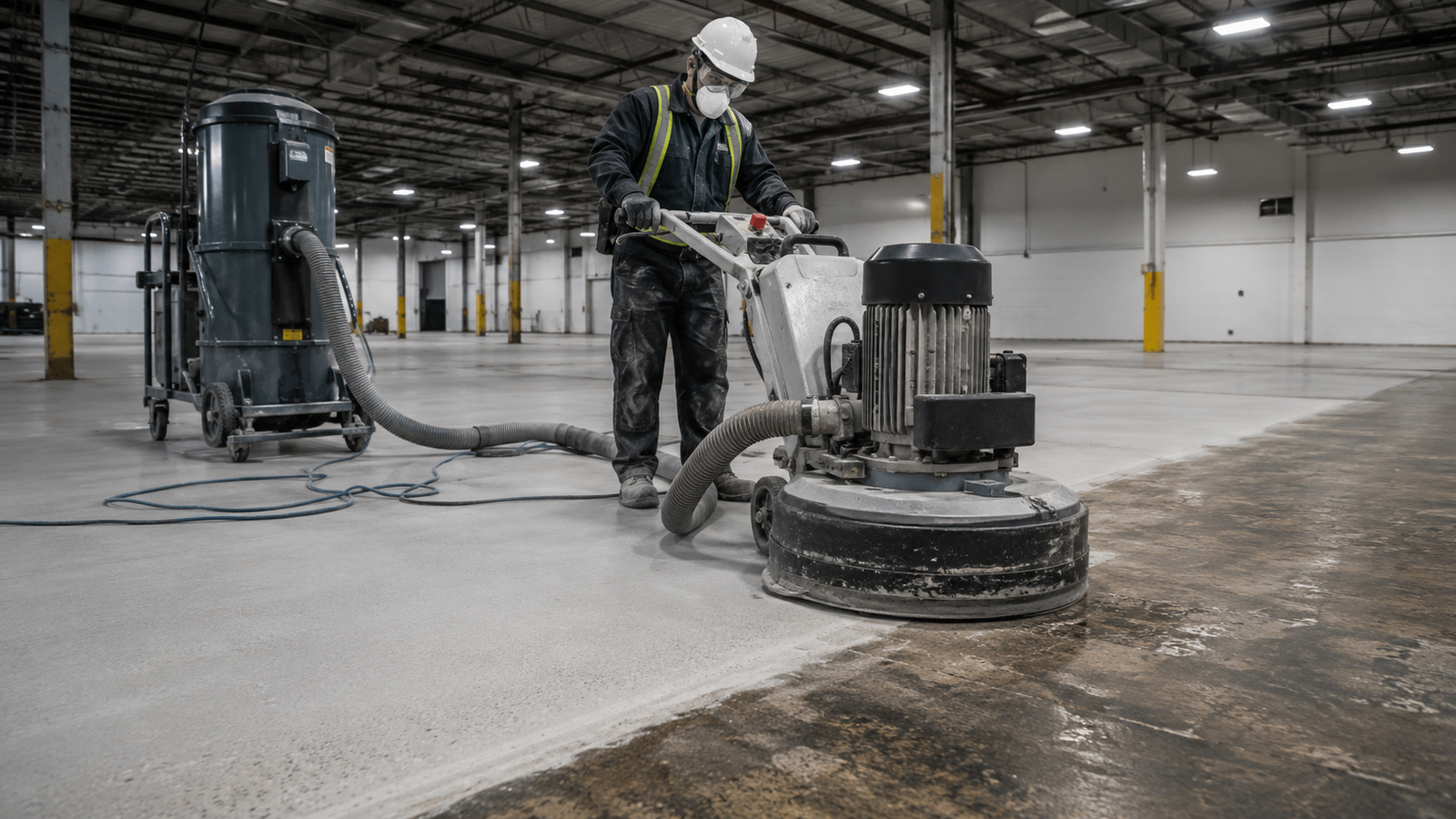
Over time, even well-maintained concrete floors develop conditions that routine cleaning cannot resolve: deeply embedded tyre marks, failed or delaminating coating systems, surface laitance, carbonation, oil penetration and physical wear from sustained heavy traffic. These conditions cannot be addressed by surface-level treatment. Diamond grinding removes the affected layer of concrete entirely, exposing sound substrate beneath and creating a clean, profiled surface ready for any subsequent treatment or coating system.
The diamond grinding process
Industrial diamond grinding uses rotating diamond-impregnated segments to mechanically abrade and remove the upper surface layer of concrete at a controlled depth. The process is wet or dry depending on the application, with dust extraction systems used throughout to maintain safe air quality in the work environment.
Grinding is performed in a series of progressively finer passes, each using a higher-grit diamond segment — beginning with coarser segments for material removal and transitioning to finer segments for surface refinement. The depth of each grinding pass, and the total number of passes, is determined by the initial surface condition and the required end specification.
Polishing for high-specification outcomes
Where a high-gloss polished concrete finish is specified — increasingly common in distribution centres, retail facilities and public buildings where appearance and ease of maintenance are priorities — the grinding process continues through increasingly refined diamond stages until the desired sheen level is achieved. Densifier chemicals are typically applied at specific stages to harden the concrete surface and enhance the final polish. The result is a surface that is harder, denser and more reflective than the original concrete — and significantly easier to maintain.
Applications and outcomes
Diamond grinding is the correct preparatory step before application of any floor coating or sealant system, ensuring optimal adhesion and eliminating the risk of delamination due to surface contamination or inadequate profile. It is also specified as a standalone restoration treatment where the client requires a clean, sound concrete surface without further coating — common in industrial environments where flexibility and ease of repair are prioritised over a sealed finish.